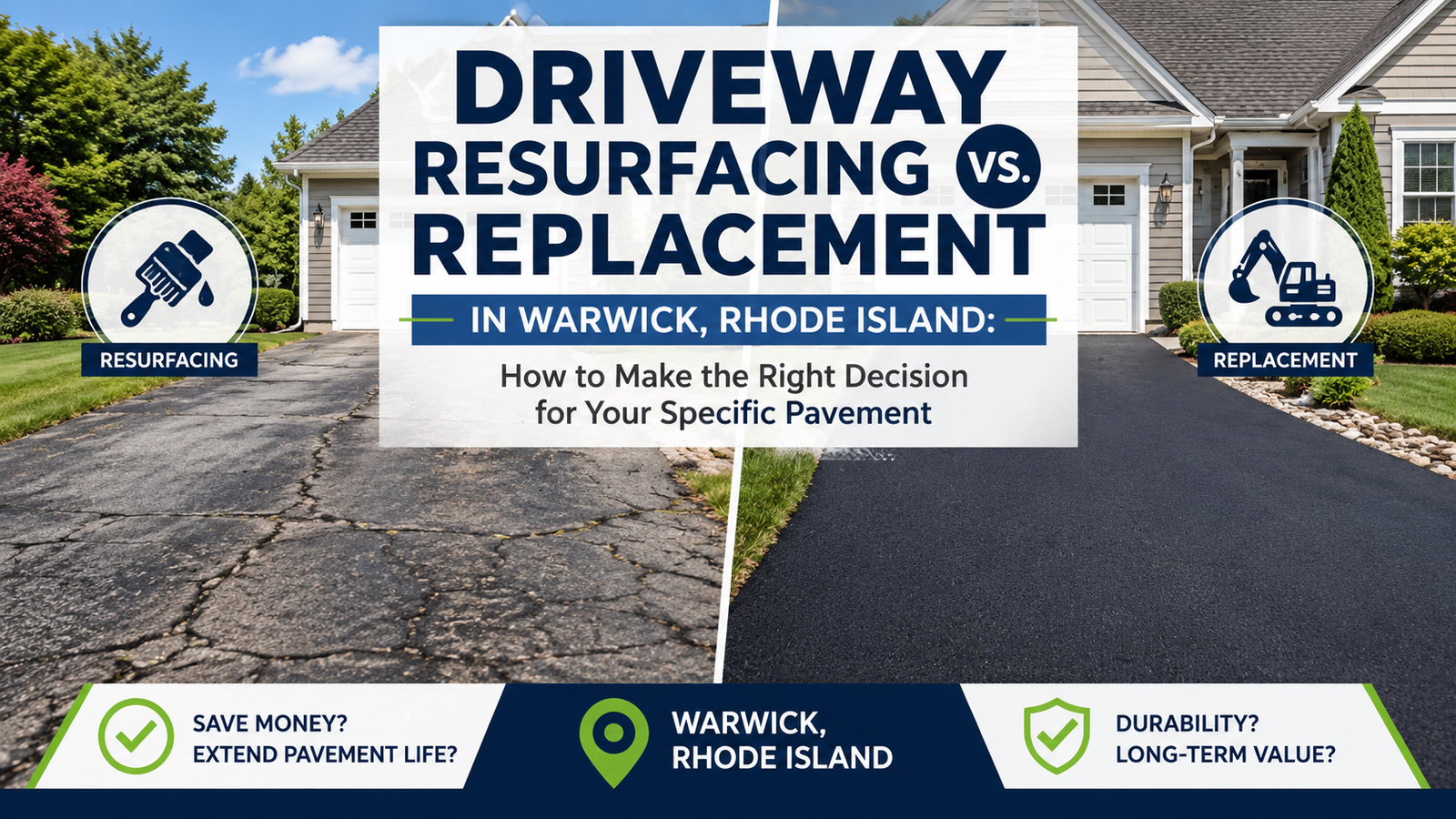
When a Warwick homeowner’s driveway has deteriorated to a condition that demands action, the choice between resurfacing and full replacement is one of the most consequential decisions they face in residential property maintenance. Resurfacing applying a new asphalt layer over the existing surface is significantly less disruptive and typically less expensive than full replacement. Full replacement removes all existing material and rebuilds the Driveway Resurfacing vs Replacement Warwick from the subbase up. Choosing resurfacing when replacement is actually needed produces a short-lived result that wastes money and still requires replacement within a few years. Choosing replacement when resurfacing would serve perfectly well wastes even more. The right answer depends on specific conditions in a specific driveway, and understanding what those conditions are and what they indicate is the knowledge this guide provides.
What Driveway Resurfacing Is and How It Works
Asphalt resurfacing also called overlay or repaving applies a new layer of hot mix asphalt over the existing driveway surface. The existing driveway serves as the structural base for the new asphalt. The new layer, typically 1.5 to 2 inches thick, covers existing surface condition, creates a fresh wearing surface, and extends the pavement’s functional life by the expected lifespan of the new surface layer when the existing base is sound.
Simple overlay (without milling) applies new asphalt directly over the cleaned, tack-coated existing surface. This raises the driveway grade by the overlay thickness, which can create height issues at garage thresholds, curb cuts, and transitions to adjacent surfaces. It also cannot correct drainage problems in the existing surface low spots that pond water in the existing pavement will pond in exactly the same locations after overlay.
Mill-and-overlay first removes the existing surface to a consistent depth typically 1.5 to 2 inches using a milling machine, then applies new asphalt. Milling maintains the existing grade relationship so no height issues are created at thresholds. It allows drainage grade corrections by varying the milling depth across the surface. It creates a textured bonding surface that the new overlay adheres to far better than a smooth existing surface. And it generates reclaimed asphalt pavement (RAP) that is recycled into new mixes at Rhode Island asphalt plants. Mill-and-overlay costs somewhat more than simple overlay but provides a better technical result for most Warwick driveway applications.
What Full Driveway Replacement Is
Full driveway replacement removes the entire existing pavement structure both the asphalt surface and, in most cases, the aggregate base beneath it down to the native subgrade. The subgrade is assessed and improved if necessary. A fresh aggregate base is installed to the appropriate depth and compacted to specification. New asphalt is placed in one or two lifts over the prepared base. The result is a completely new driveway with the full expected lifespan of a new installation 20 to 25 years in Warwick’s climate with proper maintenance.
Full replacement addresses problems that resurfacing cannot: base failure, drainage problems within the base layer, inadequate original base depth, subgrade instability, root intrusion that has disrupted the base structure, or any condition where the problem is below the asphalt surface rather than at it. When the problem is in the base, putting a new surface over it produces a driveway that replicates the old failure pattern through the new surface within two to five years not because the resurfacing was poorly executed, but because the underlying problem was never addressed.
The Diagnostic Question That Determines Everything: Is the Base Sound?
The entire resurfacing vs. replacement decision rests on a single fundamental question: is the existing base structurally sound? If the answer is yes, resurfacing is legitimate and cost-effective. If the answer is no, resurfacing is money wasted on a temporary cosmetic improvement that still requires full replacement to follow. Getting this diagnostic question right before committing to either approach is the single most important thing a Warwick homeowner can do when facing a deteriorated driveway.
The most reliable indicator of base condition is the cracking pattern visible in the existing surface. Different crack types signal different underlying conditions, and understanding the distinction is directly useful for Warwick homeowners assessing their own driveways.
Crack Patterns That Indicate a Sound Base Resurfacing May Be Appropriate
Longitudinal cracks run parallel to the driveway’s long axis. These typically form from thermal shrinkage of the asphalt surface and binder oxidation, and they do not necessarily indicate base failure. They are a surface-layer phenomenon that can be crack-sealed before resurfacing without compromising the structural integrity of the base below.
Transverse cracks run perpendicular to the driveway’s length. These form when thermal contraction of the asphalt during cold Rhode Island winters exceeds the tensile strength of the material at its weakest cross-sectional point. Transverse cracking is extremely common in New England asphalt and is considered a normal aging characteristic in the region’s climate. It does not necessarily indicate base failure when the cracks are isolated rather than interconnected.
Edge cracks and edge raveling deterioration at the driveway’s free edges indicate progressive loss of lateral confinement at the edge where the asphalt has no support structure, but they do not indicate base failure in the interior of the driveway. Edge repair combined with overlay can address this pattern effectively when the interior base is sound.
Crack Patterns That Indicate Base Failure Replacement Is Required
Alligator cracking is the definitive indicator of base failure. Named for the interconnected, polygon-shaped pattern it creates, alligator cracking develops when the pavement has been repeatedly loaded on a base that can no longer distribute loads adequately. The surface breaks into a mosaic of independent pieces that flex individually under vehicle loads, creating the distinctive network of interconnected cracks. Overlaying alligator-cracked pavement is one of the most common and expensive mistakes in driveway maintenance the new surface replicates the same failure pattern through the overlay within two to three years because the failed base beneath it was never corrected.
Rutting permanent vertical deformation in the wheel path areas indicates either base failure from load displacement or inadequate asphalt mix performance. Either cause requires addressing the structural layer, not simply overlaying the deformed surface with a new one that will deform in the same locations.
Widespread depression and localized sinking throughout the driveway indicates base consolidation or subgrade instability. These depressions collect water, accelerating freeze-thaw damage exactly where the structure is already weakest, and they indicate that the base has inadequate bearing capacity that overlay alone cannot restore.
The Field Test Warwick Homeowners Can Perform
Even without pavement engineering training, Warwick homeowners can perform a useful field assessment to evaluate base condition before investing in maintenance or replacement. Walk the driveway slowly and press down firmly with your foot in areas of visible deterioration. Sound asphalt over a solid base feels firm and rigid underfoot it does not flex or deflect under foot pressure. Asphalt over a failed base feels soft, springy, or spongy it flexes noticeably when pressure is applied, sometimes visibly deflecting a fraction of an inch before returning to position. This spongy feel is the movement of the asphalt surface over a base that can no longer support it rigidly.
A second assessment is tapping the asphalt surface with a heavy object a hammer, a heavy wrench, or a piece of rebar and listening to the resulting sound. Asphalt over a solid, well-compacted base produces a firm, sharp impact sound. Asphalt over a void or failed base produces a distinctly hollow, thudding sound. The difference is subtle but discernible with practice, and it can identify areas of base failure that may not yet show obvious surface cracking. Use the visual inspection and the physical feel-and-listen tests together across the full driveway to develop a comprehensive picture of base condition.
The Role of Age in the Resurfacing vs. Replacement Decision
A driveway’s age provides important context for the decision, though it is not determinative on its own. A 10-year-old Warwick driveway showing surface cracking without base failure is a strong resurfacing candidate the base has many years of potential service life remaining, and a new surface layer restores the wearing surface without sacrificing that remaining base investment. A 22-year-old driveway that has undergone previous maintenance cycles and now shows distress throughout may be a better replacement candidate even if the base seems borderline, because the overall structural capital of the installation is near or at its natural end and replacement provides a fresh 20-to-25-year foundation.
A practical decision framework for Warwick homeowners: if the base is sound and the driveway is under 15 years old, resurfacing is generally the appropriate approach. If the base is sound and the driveway is 15 to 25 years old, resurfacing is often still appropriate but warrants careful condition assessment and honest projection of remaining life. If the base has failed at any age, replacement is required regardless of the driveway’s calendar age.
What Resurfacing Cannot Fix Regardless of How It Is Executed
Understanding the inherent limitations of resurfacing regardless of how skillfully it is performed prevents disappointment and unrealistic expectations. A mill-and-overlay cannot correct base failure. A mill-and-overlay cannot add bearing capacity that the base does not have. A mill-and-overlay cannot address subgrade instability below the base. These conditions require removal and replacement, not overlay. An experienced Warwick paving contractor who recommends overlay on a driveway with clear base failure is either making an assessment error or prioritizing a lower-ticket sale over the homeowner’s actual need. Conversely, a contractor who recommends replacement for every deteriorated driveway without assessing base condition specifically may be recommending more work than the situation requires.
Common Questions About Driveway Resurfacing vs. Replacement in Warwick
How long does resurfacing last in Warwick compared to full replacement? A properly executed mill-and-overlay on a sound base in Warwick typically extends functional driveway life by 8 to 15 years, depending on traffic, maintenance, and drainage conditions. Full replacement with proper base construction provides the full 20-to-25-year new installation lifespan. The choice involves weighing the remaining expected life of each option against the relative investment required.
Can resurfacing correct drainage problems in my Warwick driveway? Mill-and-overlay can correct minor drainage grade problems by varying the milling depth to re-establish the desired cross-slope. Significant drainage problems related to the base elevation, subgrade conditions, or major grade errors require full replacement to address adequately. Identifying which category your drainage problem falls into is part of a thorough pre-resurfacing assessment.
What if only part of my Warwick driveway has failed base? Targeted full-depth patch repair of failed sections removing and replacing the failed pavement and base in those specific areas combined with resurfacing of the remaining sound sections is a legitimate and cost-effective approach when base failure is genuinely localized rather than widespread. This hybrid approach requires accurate identification of the failed zones and their boundaries before work begins.